Upcoming Event: Football versus Southeast Missouri on September 5, 2026 at Noon


05.06.2008 | Football
AMES, Iowa - Mike Andresen has been there. Iowa State's manager of athletics grounds came to ISU in 1996 as athletics turf manager to oversee implementation and maintenance of Jack Trice Stadium's all-natural grass football field. It should come as no surprise that with Andresen's care, a field that was slated to last in top condition between four and six years, lasted 12 seasons.
Iowa State's field has been recognized nationally several times as one of the best football gridirons in the country. But even the best fields have a finite life span.
“We played on (the field) for 12 years, which is phenomenal,” Andresen said. “Over a period of a dozen years you build up a thatch layer. Our thatch layer got to be four to five inches thick. We have a sand-based field and the sand will drain water as fast as you can put it in. However, the five-inch layer of thatch holds up water, so we were due for a rain, mud disaster game.”
While no such game occurred, in addition to the sod itself there were other challenges. The biggest battle was against an annual type of blue grass that was penetrating the original field grass. Its annual growth was difficult to deal with because it was essentially a weed without roots. Chunks of grass began flying up during games last season. By the time of the spring game, brown spots that had developed during a harsh winter left random patches of no grass on the field.
Andresen's crew went to work. A milling machine grinded off and twice carried two inches of thatch from the field last week.
“The days of stripping sod with a cutter are over,” Andresen said. “Now a milling machine grinds it out just like asphalt in the concrete business. We then used a laser grader which got our field to a better grade than it was originally. It is a superb grade now. That took one day and then it took two days to put down the sod.”
Andresen said that some nutrients were put into the top three inches of sand before they laid down the field.
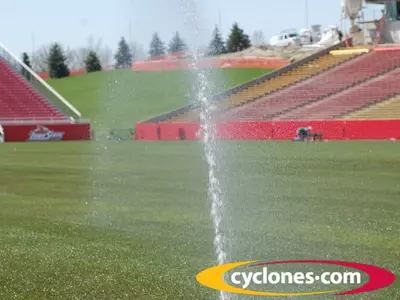
“Some of the nutrients that don't move through soils were put in,” Andersen said. “Now, we will water the field and keep it wet for two weeks. If it dried up, it would shrink and we don't want that to happen so we keep it soaking wet for up to two weeks. When the blue-white roots start to anchor in the sod, we will wean it off the water and resume normal watering the rest of the summer.”
Andresen lauded the contractors who have assisted in the project, Bush Sports Turf out of the Quad Cities.
“These people did a great job,” Andresen said. “The grass they put in is top shelf.”
The field will have to be ready by the August 28 season opener against South Dakota State. With Andresen's steady hand, it will be ready.