Upcoming Event: Football versus Southeast Missouri on September 5, 2026 at Noon


10.20.2009 | Football
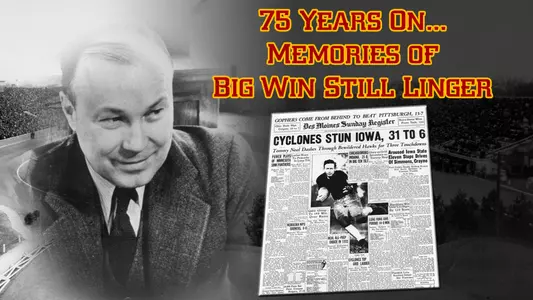
AMES, Iowa ? The Iowa State-Iowa football series has long stirred the passions of Cyclone-Hawkeye fans since the two teams played each other for the first time in 1894. In the benefit of hindsight, several contests in this rivalry stand out as watershed moments that portended a sea change in the series. Iowa State's 31-6 win over Iowa 75 years ago on Oct. 20, 1934 is one of those moments. Few who watched it at State Field (later Clyde Williams Field) could imagine that the two schools would not meet again on the gridiron for 33 years.
In 1934, Iowa State College continued its mission of educating students in the large, dark shadow cast by the Great Depression. Despite the economic pressures, there was some room for optimism. Enrollment was up and dorms almost full as 3,249 students came to campus for the fall term. Iowa State athletics provided one avenue of entertainment or distraction to take one's mind off of the challenges at hand.
Iowa State opened its fourth season under head coach George Veenker with wins over Luther (23-3), Grinnell (26-6) and at Missouri (13-0). The Cyclones had not won its first three games since 1917. Now the looming Iowa game figured to be one of the biggest games Iowa State had ever played.
The teams had met nearly every season between 1894 and 1920. Clyde Willliams, a former Iowa quarterback, had been football coach at Iowa State from 1907-1914 and athletics director through 1919. Universally respected, Williams was a key figure in the life of the intrastate game and his Iowa connections and sterling reputation kept the series from becoming a feud. But Williams left to enter the automobile industry and almost immediately, ties for future gridiron games were severed by deteriorating relations between the athletics departments of the two schools. The series was resurrected for the 1933 and 1934 seasons, possibly a response to an acute need for revenue at both schools. Iowa beat Iowa State 27-7 in the first contest in 1933.
Outwardly, Iowa was advocating the continuance of the series after 1934. Witness the quote from Hawkeye head coach Ossie Solem in the game day program.
“We wish the finest luck and good wishes to the men of Iowa State College we are looking forward to further meetings of this kind, in the hope that we might further cement this friendship existing between these two great institutions.”
There were changes in rules before the start of the 1934 season, some in favor of the passing game. Incomplete passes in the endzone would no longer be an automatic touchback. The ball was smaller and the penalty for clipping reduced from 25 to 15 yards.
On the Thursday before the game, famed aviatrix Amelia Earhart spoke about her career to the crowd of 3,500 in State Gym after a faculty reception in the Oak Room of the Memorial Union. Earhart saw her first plane at the 1909 Iowa State Fair when her family lived in Des Moines. It was three years before Earhart perished while attempting to be the first person to fly around the world.
The ISU athletics department prepared itself for a Saturday onslaught of more than 500 cars. On Lincoln-Way across from campus, the Capitol Theatre showed the movie Million Dollar Ransom that Friday night, starring Phillip Holms and Edward Arnold. At the Ames Theatre Robert Montgomery and Maureen O'Sullivan were featured in the movie Hideout. The late show was the Scarlet Empress staring Marlene Dietrich. Before 4 p.m. you could see the movie for 28 cents. In the evening admission was 36 cents.
Friday night at 6 p.m. in the Memorial Union, the ISC football team ate dinner with members of the 1894 team who were in town for a 40th anniversary reunion. At 7:30 p.m. the party went to State Field for a rally. Getting into the Pep Dance at State Gym cost 15 cents.
Saturday dawned cloudy and cool. Few suspected an Iowa State victory was in store as nearly 17,000 fans, the largest crowd in ISC history, worked and wormed their way into the stands. But Iowa State head coach George Veenker was doing what he could to prepare his team for the intrastate rivalry. Cyclone quarterback Tommy Neal told Ron Maly of the Des Moines Register in 1977 how the ISC head coach inspired his charges.
“(Veenker) was a master psychologist,” Neal said. “(Veenker) got us fired up for the Iowa game by bringing up some of the thing Ossie Solem (the Iowa head coach) had said. It had been in the newspapers that Solem couldn't find a place on Iowa's schedule for Iowa State (in the future). He implied that we were some kind of cow college and he said he wanted to play some schools from the east instead of us. When we saw those comments, you can imagine how we felt. The mood on campus was wild. All the students got excited.”
Veenker had come to Iowa State from Michigan where he was head basketball coach and assistant football coach for the 1931 season. He attracted national attention when his first Cyclone team (1931) won five of its first six games after going winless in 1930 under Noel Workman. Described by some as almost taciturn and striving not to be the center of attention, Veenker was respected by his players who had witnessed how he put the welfare of his students ahead of personal gain. LeRoy “Cap” Timm, who had lettered in football and baseball at Minnesota, had joined the Iowa State staff that fall as a trainer. He would gain fame as one of the greatest coaches in Iowa State history who would take the Cyclone baseball team to the College World Series in 1957 and 1970.
Veenker had his hands full coming up with a plan to stop Iowa's attack that was led by fullback Dick Crayne and the Hawkeyes' star return man and ball carrier Ozzie Simmons. Simmons had led Iowa to a win over Big Ten powerhouse Northwestern that fall. He was an early African-American player, a second-team All-American as a sophomore in 1934 and one of the most exciting ball carriers of his time.
Despite the challenges, this day would belong to Iowa State. Veenker had a surprise for the Hawkeyes.
“We crossed Iowa up by going to the double-wing formation,” Neal told Maly. “They expected us to use the short punt.”
Des Moines Register sports editor Sec Taylor, who also helped officiate the game summed it up in the Sunday paper as Neal earned the accolades.
“Tommy Neal, an all-state midget of 155 pounds from Sioux City and Fred Poole, a kicking fool from Ames High plus their inspired Iowa State College teammates wrote football history here Saturday when they humiliated Iowa by the almost unbelievable score of 31-6.”
Poole, an end who also did the punting, averaged an incredible 54.4 yards on 12 punts while trying to kick the ball away from Simmons. His performance meant that Iowa was repeatedly pinned deep in its own territory, negating Simmons' impact. The Hawkeye fumbled two times to set up Iowa State touchdowns. Early in the second quarter with the Cyclones leading 3-0, Simmons fumbled a bad snap and ISU's diminutive lineman Ike Hayes recovered.
Hayes was a fierce competitor who made up for his tiny 5-6, 158-pound frame with almost fanatical zeal. The pre-veterinary medicine major was the brother of future Ohio State coach Woody Hayes. Neal scored on an 8-yard run two plays later and it was 10-0 ISU.
Taylor recounted a moment when after the whistle had blown. “Hayes looked at me and said ?football is a grand game, isn't it?'”
Late in the first half, Simmons fumbled another Poole punt and Iowa State recovered the ball at the Iowa 17. Two plays later, Neal dashed 12 yards for the touchdown and Iowa State had a 17-0 halftime lead.
The Iowa State band, made up of 75 men who stepped on the field in natty gray-blue uniforms, stepped onto the field for its halftime show. Under the direction of Music professor Oscar Hatch Hawley, the band had been organized by its conductor in 1920. They practiced in the open spaces of campus or on the fourth floor of what is now Carrie Chapman Catt Hall.
An Iowa State turnover set up Iowa's one score in the third quarter. But Iowa State countered with a 28-yard TD dash by Neal and a 24-yard scoring run by Harold Miller, who had actually started the game ahead of Neal.
As the game came to a close, a lone plane circled above Clyde Williams Field. It was Veenker's brother saluting his sibling by making an aerial appearance.
At the Des Moines Register, the sports desk listened to the radio with disbelief. The writers had planned the Sunday sports front page with a drawing of Simmons. Now they had to scramble for another imagine. Fortunately, they found a picture of Neal from his high school days.
The desk workers on the Register sports desk frantically began calling Sioux City to find out more about Neal, an engineering major. Of Neal, the Register wrote that he was the “scion of one of Sioux City's affluent families. With the sounding of the final gun, the students, shouting and in some cases, sobbing with joy, swarmed over the field, lifted their victorious gladiators to their shoulders and bore them off the field.”
After the game, Solem had great praise for Poole but his comments to the media implied that there wouldn't be another game between the two schools for some time.
“That was the most marvelous kicking I have seen in all the time I've been watching football,” Solem said. “Iowa State had a fine team, well-coached and inspired for us. I feared a defeat but I had no idea that the score would be so high. It goes to prove that a team can not successfully play a conference schedule and then take on a team like Iowa State that will be keyed up for the game.”
For his part, Veenker, a man of few words, had little to say.
The Iowa State Daily reported “the stunned crowd left the stadium and the stunned sports writers, most of them University of Iowa men, began collecting their wits.”
Poole said his kicking training was a year-round endeavor.
“During the summer, I accompany my friends on trips to the golf course,” Poole said. “But instead of playing golf, I try to increase my punting distance by kicking the football around after the boys.”
After the game, crowds of young boys, some of whom had watched the game from telephone poles and trees outside the stadium, waited patiently for their heroes to walk out of State Gym. As it began to rain, Neal and Poole posed with 1894 Cyclones Dr. C. I. Rice and Dr. I.C. Brownlee. Many fans did not want to leave and wandered campustown trying to hold on to the moment.
“Ames went wild,” Neal told Maly. “Old Iowa State was really floating that weekend,” he said. “I think everybody who ever had any booze stashed away (because of Prohibition) got it out after that game.”
That night Fred Mauck and his Orchestra entertained students and faculty at a dance in the Memorial Union. A ticket for 39 cents got you into the party.
Football fans of the two schools would wait a long time for another game. Solem did not return Veenker's phone calls about scheduling a future contest. At the 1935 Drake Relays, Veenker encountered the Iowa coach and expressed his desire to continue the rivalry. Solem told him that he would be in touch. He never called.
It wasn't money that ended the series. Longtime ISU business manager Merl Ross recounted how Veenker told him to send Iowa a larger check than what the Hawkeyes had sent to Ames for the 1933 game. Nevertheless, it would take tenuous negotiations and the lingering threat of legislation to finally get the intrastate rivalry resumed in 1977. The game would not return to Ames until 1981.
A quarter century later, the 1934 Cyclones returned for their 25th reunion and watched the 1959 “Dirty Thirty” Cyclones continue their winning tradition. The 1934 team would attend the resumption of the series on Sept. 10, 1977 at Kinnick Stadium in Iowa City.
Today the Iowa State-Iowa game is the state's biggest party. Thousands and thousands of fans come to the stadium on game day, many without a ticket. Today it is inconceivable that the season would not include the rivalry. Both sides have since had their day in the series.
There can't be at best a handful individuals still alive who watched the 1934 game that day at State Field. But if they were here today, they would tell the rest of us that we missed the best game in the series -- for Cyclone fans.