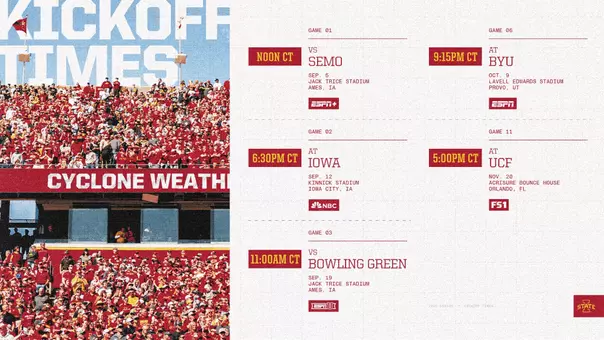
Upcoming Event: Football versus Southeast Missouri on September 5, 2026 at Noon


03.04.2021 | Football
AMES, Iowa - Iowa State head football coach Matt Campbell met with the media this week. Here are the highlights.
Q: How do you expect your team, this spring and throughout the summer, to handle the expectations that it'll have, not only at Iowa State, but also at a national level?
A: I think we've really had to deal with that the last three years, so I don't think much has changed other than maybe what we've learned along the way. I think what we've learned along the way is diving back into who we really are. Our purpose, and our process, has kind of been worrying about us and not worrying about anything other than those things.
Q: In looking at the statistics, the conference has shown a lot of movement, from a defensive standpoint, over the past couple of years. What do you attribute that to and, specifically, in your program where you guys have gotten better?
A: I think, number one, the influx of new defensive coaches. I think there have a been a lot of changes in the conference to where we are now. There certainly has been an emphasis on the defensive side of the football. A little bit, as well, in terms of the scheme, you've seen a shift schematically to trying to defend some of the offenses and certainly some of the talent that has existed in the Big 12, especially over the last 10-12 years of what you saw with Oklahoma and Oklahoma State and Baylor. With the explosive offenses and personnel, I think you had to find ways to be able to defend those things and I think the evolution of that, not just within our conference, but nationally has started to catch up from a football standpoint certainly over the last five years. You've seen a big shift in defending the spread offense and some of those things that were so prevalent in the Big 12 have really started to come full circle.
Q: When you look at these high scores, how do you determine what is a good defense?
A: We talk in our program that it's not about the defensive numbers or statistics, it's about being complementary. We have to understand that our program has to complement each other for us to have success. And what I mean by that is, in terms of looking at these statistics, it's really what allows us to be successful and how do we complement each other within a football game and within a season to allow us to get to the end result, which the end result is, obviously, to try and win the game. I think we spend a lot of time in those areas and I think one of the big things from our end of it still comes down to situational football. The ability to get off the field on third down, the ability to get off the field on fourth down, the ability to win in the red zone, those things are all big, especially when you see offenses having the consistency to drive the football and put points on the board. I think when you look at it from a holistic model, we really talk more complementary football and what it's going to take to win week in and week out and how can the offense help the defense, how can the defense help the offense, and obviously special teams complement everybody involved.
Q: What type of impact will a full offseason give this team with Dave Andrews?
A: That's one thing, when you look at what happened a year ago in college football, where probably a lot of other coaches are talking about spring practice. I would talk about the physical development that can occur in the months of March, April, and May. This is one of the things that we missed on is because so many kids were in so many different areas and doing so many different things in this quarantine process a year ago. You really had three months that you really didn't have your hands on the development of your players and one thing that can be really big for, not just our program but for any college football program right now, if done correctly, is the development that we can gain back that was really missed from a year ago. The greatest development that I see that can occur is maybe not from a football standpoint but from a physical standpoint. I know we're really excited about that and a lot of my time has been spent on how to maximize those opportunities to develop and grow from a physical place just because I think those are some things that we really lost a year ago and hopefully can only continue to add to our growth and development as a football team.
Q: What was the conversations and decision-making processes like for your guys, who in normal situations would have been out of eligibility, if not for the blanket eligibility waiver, where obviously you've got a good chunk of those guys coming back?
A: I think, from my end, the biggest thing we tried to do is just help our guys make the best decision for them and their families. Quite honestly, it was the opposite of anybody trying to recruit anybody coming back. We're very grateful that there's a good portion of our young men that decided to come back to school and I think a lot of those guys revolved around the question of development in the weight room, where they saw an opportunity that they missed three really good months that maybe those three months would have helped them to continue to grow. I think some of our young men saw it as an avenue where, educationally, it was an opportunity to maximize another year, whether they were pursuing or finishing a master's degree. I think a lot of things that we tried to provide is the best feedback we can give them. Some of them were thinking about a National Football League career and some were talking about an educational career immediately after graduation and here are the resources we can provide you. I think it was really interesting for me to go through that. It was very influx in August and the conversations were certainly a lot more detailed in December before we got into the Big 12 Championship game and then, obviously, the bowl game, but our lines of communication stayed open the entire time. It was a very unique process but a process that was great to see our student-athletes be able to have a choice and a lot of them used that opportunity to come back here and, obviously, we're excited about that.
Q: What are your response on the Deon Broomfield hiring and what unique perspective he's going to have and what can everyone expect from him as the safeties coach?
A: You are always looking for ways to better yourself and you're always looking for ways to grow your program. I always see an opportunity to bring somebody new in as a huge opportunity for growth. You bring somebody like Coach Broomfield back to Iowa State, who chose to come to school here at Iowa State, had a great career here at Iowa State, actually played in some and had some of the biggest plays, maybe prior to us getting here, in the history of this school, and a guy that is respected by everybody within our university on the academic side, on the social side, in terms of our athletic training room, in terms of everybody that's touched this program thinks the world of Coach Broomfield. Then you see a gentleman that has success, goes to play professionally, then has the opportunity to get into coaching and instead of starting on the high end of things, goes back to starting in Division III football and working his way up to where he gets to the National Football League as the assistant DB coach with the Texans and then wants to come back to his alma mater. It's huge. It's huge for our players to see somebody that was in their shoes at one point, that had the ability to have success and go on and play at the next level and then also see somebody in their shoes succeeding in their professional field at the next level. So, I think it's already had a huge impact and huge positivity in our hallways, so we're really excited to have Coach Broomfield here.
Q: In talking about Coach Mouser, someone who's been with you back in your Toledo days and has been with at Iowa State. What do you feel like he brings to you staff as a position coach now?
A: Coach Mouser is an incredible relationship-driven person. He's a great servant leader. He knows how to develop tremendous relationships and trust with not only the coaching staff, but the players and I think that's a huge value, it's who we are. Seeing his growth over the last seven years together, it's been really enjoyable to watch. From a technical standpoint, Coach Mouser has made himself into an elite technician. He's studied the game; he's studied some of the great players that have had success both at the tight end position and the receiver position. From a skills standpoint, is maybe one of the great skilled technical coaches that I have had the opportunity to be around and he's put a lot of time and effort into really growing that craft. It's interesting to see because you see the Allen Lazard's, you see the Hakeem Butler's, and you see those guys and they come back and really work with Coach Mouser. I think that is a credit to him being able to provide those resources to good players to make good players better. You also saw that last year as he shifted his focus to the tight ends and their growth and development. I'd say the last piece, from a recruiting standpoint, is Coach Mouser has always been a great evaluator and he's been on the front-end of some of the evaluation pieces. He has always had a really good eye on the type of player who will fit in our program.