Upcoming Event: Soccer versus Colorado on September 17, 2026 at 6 p.m.

6 p.m.
Soccer
Colorado


.png&width=70&height=70&type=webp)


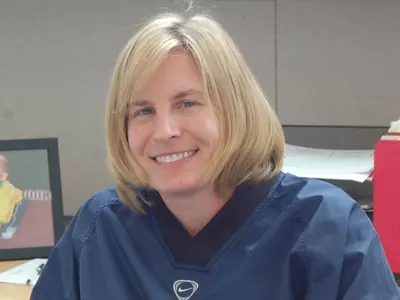
02.26.2008 | Soccer
AMES, Iowa -- Iowa State's new head soccer coach Wendy Dillinger brings a resume rich in achievement. Considered the greatest player in Indiana University history, she played professionally in the U.S. and Europe and served as an assistant coach at her alma mater. Dillinger has spent the last six years as head coach at Washington University in St. Louis. At Washington, she posted an 86-25-8 record and took the Bears to four NCAA Tournaments, three University Athletics Association (UAA) outright team crowns and a co-association championship. Cyclones.com sat down last week for a conversation with Dillinger.
How did you get involved in the ISU search for a new coach?
“I was contacted by (ISU senior associate athletics director) Dr. Calli Sanders that I'd been nominated for the position. I sent in my application, did some research and felt this would be a great step for me.”
What piqued your interest?
“Being in the Big 12 Conference, just looking at statistics on the team and what I've heard about the program. There is a lot of potential to really step up quickly.”
The tuition, room and board at Washington is around $50,000 per academic year. How did you recruit NCAA Tournament-caliber student-athletes to such an exclusive school?
“Recruiting (at Washington) is interesting. It's a nationally known institution. We focused on quality student-athletes, who were financially able to afford that education. So it's just a matter of figuring out who is going to get in, because they also do a great job at meeting needs at the institution. We actually targeted Division I level players and recruited them to our school.”
You grew up in the St. Louis metro area where soccer is big. Did this impact you?
“I started playing when I was five. My mom actually had to bribe me to go to dance class by buying me a soccer ball. In second grade, I started to realize I was a good player. My father would give me $5 for every goal I scored, that was our little wager. By second grade he had to buy me an Atari so he said that was the end of the payoffs. I started out playing with boys in club ball because there wasn't a girls team. In third grade I was playing with the boys before I started going to a catholic grade school and they had a (girls) team. In the fourth grade I went to a summer soccer camp in St. Louis, it was Busch soccer camp back then. There were two players from (University of Missouri-St. Louis), Jan and Joan Gettemeyer from Munsel that were working the camp and they asked me to play on their select team. Today, both of them are in the UMSL Hall of Fame. That's where it started.”
Were you active in other sports?
“I was a three-sport athlete. I played basketball, softball, and soccer. Then I did soccer and softball year-round. I went to Saint Charles West High School. We went to a few tournaments with club soccer. We ended up going to regionals, but the showcased events weren't what they are now.”
How did you end up at Indiana University?
“I actually joined JB Marine, which is a soccer club in St. Louis, after my junior season. It was just because I was leading the state in goal scoring they'd asked me to play for them. The coach for that team was good friends with the late Joe Kelly, who started the women's soccer program at Indiana.”
You were playing at a time when women's collegiate soccer was really blossoming. Having been involved in both levels, what's the biggest difference between Division I and III soccer?
“Size, speed and athleticism. It's not the actual game itself. (Washington) was among the top teams in Division III. We were able to play...we moved the ball. Even in (NCAA Division III) we didn't have the same athletes that you'd see at a Wheaton (Ill.) College or even The College of New Jersey, teams we faced in post season. We didn't have the same type of kids. Our teams were smaller, not quite as quick, but smarter, which translated to understanding tactically a little more on the field. We actually played last spring against two Division I opponents and tied both games.”
Now that you've had an opportunity to meet the Iowa State team, what were your first impressions?
“They work very hard, have good attitudes and are driven. I think the potential is amazing with some really talented players in the group. My focus with them is going to be to get them to move the ball better, possess it better and quicker and have a more organized attack.”
Do you expect to recruit nationally? What is your recruiting philosophy?
“We will go after the best players. What is a great soccer player? Obviously someone who possesses athletic ability, skill, is technically capable of doing some things and controlling the ball. We want individuals who play with sophistication and vision, can beat a defense individually, but also be effective as a team player.”
You had opportunity to play professionally? How did that opportunity impact you?
“I love to compete. I love to win and hate to lose, that's key. My parents pushed me pretty hard. From a very young age, expectations were always really high. But the other thing I think was having the talent so early there was an expectation from my teammates, the parents and my coaches, that I was going to get the job done. So you kind of grow up with that weight on your shoulders, so to speak. You just learn to operate that way.”
What was your highest moment as a collegiate player at Indiana?
“I would have to say the year we beat Wisconsin. It was my junior year. They were ranked in the top-25 and we beat them 1-0. I scored a goal playing against Marcy Miller, who now is the coach at Baylor. She was with the national team for a while, so I would say that was one of the highlights.”
Was playing overseas (Denmark) an eye-opening experience?
“Culturally, it was an eye-opening experience. Denmark is very liberal. I was exposed to many things I hadn't seen before when growing up in the Midwest. They just played a different brand of soccer. I remember one of the first games, a lot of (my teammates) didn't speak English. (Her teammates) were trying to tell me I had a player on my back, and they'd yell ?back' so I turned around and played the ball backwards.”
Is it more nerve-wracking to coach than to play?
“Occasionally, if you do your job well in training, you don't have to do a whole lot of coaching during the game. You might have to make an adjustment here or there, or remind somebody about their role and responsibility, but if you do the work in the training, you can actually sit back and watch parts of the game. You can't do that as a player.”
Was there a high moment for you at Washington University?
“There were many. The first conference championship we won was in my second year as head coach. We played University of Chicago, which was ranked No. 1 in the country at that time. The eventual national player of the year was on that Chicago team. We upset them at their place, 2-1, in overtime. That was very rewarding, especially since we had a group of seniors who had played for me for two years and really wanted to end on a great note. That team had set a goal and then went out to achieve it. We beat Wheaton (Ill.) College twice and both times we beat them they went on to win the national championship. You know you're really close when you're doing those types of things.”
What are your goals for the ISU soccer program?
“In the short term I want us in the top-half of the Big 12 and to be able to compete with the top schools. If you look at (Iowa State's shootout loss vs. Texas A&M in the Big 12 Tournament) this team is already close to it. I will work to put it together, try to create more scoring opportunities, be organized in the attack, etc. In the long term, the goal is to win the Big 12 and advance in NCAA postseason play.”