Completed Event: Men's Wrestling versus Harold Nichols Cyclone Open on January 18, 2026 , , One Champ

Final
Men's Wrestling
Harold Nichols Cyclone Open
One Champ


12.20.2016 | Men's Wrestling
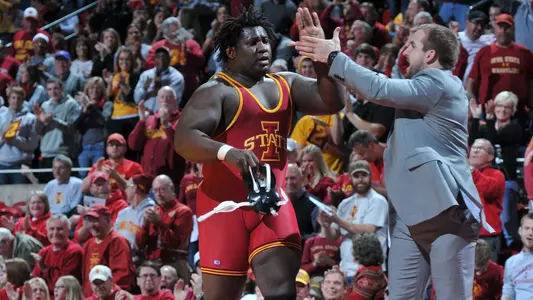
When Quean Smith graduated with a degree in Liberal Arts on Saturday, he became the second member of his family to earn a college degree. The Iowa State heavyweight's walk across the stage at Hilton Coliseum was one that many, including Smith himself, once thought to be impossible.
Growing up, Smith came to the understanding that education would end with a high school diploma. That was the case until he saw a first cousin graduate from Duke University.
"Seeing him do that made me think I could do that," Smith said. "That was the first time I had really considered trying to go get my college degree."
Although Smith had his mind set on going to college, the obstacles seemed overwhelming at times. He is one of many that struggle with dyslexia, a learning disorder that causes difficulty in learning to read and interpret words. To go along with this hurdle, Smith references his inner city Detroit high school, stating, "People from Highland Park don't go D-1."
His journey looked to be on hold until his wrestling coach suggested they go to Chicago to watch the Midlands Championships. In particular, he wanted Smith to watch the Iowa State wrestling team and head coach Kevin Jackson.
At the annual holiday tournament, Smith and Jackson hit it off right away. Smith could tell that Jackson and Iowa State were the perfect fit for him. He wanted to know more.
"We had a connection right away," Smith said. "With him being from Michigan too, I think we kind of shared that connection."
"I could tell he was a quiet kid," Jackson said. "We didn't really know much about him coming into that meeting, but we went back to Ames and started watching film on the kid and realized the athletic specimen that he was."
Shortly after this, Smith was invited to campus for a visit. His host was 2015 National Champion Kyven Gadson. Smith said Gadson's hospitality on that trip opened his eyes to what Iowa State could offer.
"I fell in love with the campus right away," Smith said. "Kyven showed me around and after that visit, I knew that I wanted to be a Cyclone."
However, Smith struggled to become eligible for admission into Iowa State. A few of his high school classes would need to be retaken, and he would be forced to take the ACT six times.
"It was discouraging," Smith stated. "Each time I got the score back, Coach Jackson would call me and tell me to keep my head up and to keep going, and they still wanted me to come."
"We never gave up on him because we knew what he could be," Jackson said of Smith. "He was an athletic heavyweight that had low-single attacks and high doubles that we knew could compete with the best in the country."
As Smith walked in to take the ACT for the sixth time, he told himself that this was it. He had determined that if he did not qualify this time, it probably was not meant to happen.
Luckily for Smith, this time was different.
"When I got the call and they said, 'You qualified, you can come' I had never been so happy," Smith said. "I remember crying because I had done it."
Once on campus at Iowa State, Smith encountered his next set of obstacles. He would have to battle adversity on the mat, in the classroom and personally.
"It took us a full year to get Quean to campus," Jackson said. "We weren't really aware of his learning disability and when we put him on the scale, he was weighing over 350 pounds. That wasn't the Quean Smith that we had offered a scholarship to."
Smith's dyslexia was not discovered until he arrived on campus, and would be a hurdle that many said couldn't be surmounted. The coaching staff was told that Smith wouldn't make it more than a month at Iowa State.
To go along with the academic hindrance, Smith would need to lose 65 pounds before he could even think about putting on an Iowa State singlet.
These concerns only began to scratch the surface of what Smith would need to do to start, let alone finish, his career at Iowa State. Within himself, and at home, conflict boiled.
"I had people calling me from back home asking me when I was coming back," Smith said. "They said, 'Boys like you don't go D-1. You won't make it more than a semester' and I kind of started to believe them too."
Adapting interpersonally was a struggle, too. Smith was quiet and reserved and rarely spent time interacting with his teammates or roommates.
"I had roommates, but I didn't talk to them," Smith said. "I just kind of kept to myself and stayed in my room."
To take it a step further, Smith's past haunted him. His experiences and visions in Detroit followed him to Iowa State and hindered his social, academic and athletic process.
"That first year, I had demons," Smith said. "I wouldn't be able to go to sleep until five, five-thirty in the morning. I'd get calls from back home that so-and-so had been shot, or that so-and-so had been killed. It was tough to focus on my school and my wrestling with all of that."
Something changed for Smith, something that he had never been able to do. He started talking to people.
"I first told all this stuff to KJ," Smith said. "Then I was able to talk about it with the people at Hixson-Lied. Before that, I didn't feel I could talk to or trust anyone like that other than my mom."
Way back at the Midlands Championships, when a quiet Smith had first talked to Jackson, the 1992 Olympic Champion knew that he and Smith had a connection.
"I knew right away from talking to him that he was opening up to me," Jackson said. "For a young man who grew up in Detroit and had been put in the situations he had been put in, it was important for him to do this."
The summer after his first year on campus, Smith's fortune appeared to be turning in his favor. The once severely overweight heavyweight now weighed 290 pounds heading into the fall of his second year. He had a clearer mind, and a new outlook on his academics.
"I was talking with an advisor after I was failing a couple of classes," Smith said, "He said, 'It's okay Quean, everybody has these troubles from time to time,' but I didn't want to be that kid who had troubles, I knew I could do better than that. I know that it's hard being a student-athlete, but I wasn't going to let that be a disability too."
Although his dyslexia still plagued him, Smith now knew what he was up against. His troubles in the classroom were no longer a mystery and he was receiving the help he needed to be successful, even if there were a few speed bumps.
"Reading in front of the class is still tricky," Smith said, "Every once in a while I'll say something kind of funny, but I'm not embarrassed by it anymore."
All the while, Jackson and his coaching staff never gave up on Smith. They continued to see progress and acts that defied what they assumed would happen to Smith after he arrived on campus.
"There were times where we were at our wits end with him," Jackson said. "But he continued to push forward and showed us why we should have belief in him."
Smith became a staple in the Iowa State starting lineup, becoming the Cardinal and Gold's starting heavyweight in his second season. Jackson says he saw further interpersonal development from Smith as he traveled with the team and made connections with his teammates.
At the end of his redshirt junior year, Smith began to realize that he was going to reach the goal that he set out to accomplish. He was starting to see his dream become a reality.
"It wasn't until the end of last season when it finally started to hit me," Smith said. "My advisor showed me the classes I needed to graduate next semester and it finally hit me."
On graduation day, Smith had 25 guests in attendance at the University ceremonies. None of his family had ever been to Ames or Iowa State before this occasion. What they received during their inaugural visit is what Smith calls the greatest gift he could give them.
"Being the first born son in Detroit, the best gift you can give your mom and your grandmother is a college diploma," Smith said. "I'm excited that nobody can take that away from us."
Smith plans on using his degree to help kids with learning disabilities like his own. He says that has been his passion during his whole tenure at Iowa State.
If that were the end to Quean Smith's journey as an Iowa State student-athlete most would call it impossible. The thing about this story though, is that its ending has still yet to be written.
"I've always told our senior administrators that regardless of Quean's accomplishment's on the mat, we'll be happy that we gave him this opportunity," Jackson said. "He'll never have to go back to Detroit and face the things that ultimately could have been deadly to him."
Jackson alluded to what he thought Smith's accomplishments in the classroom could mean for his mark that he'll leave on the mat.
"I think our expectation is now that he doesn't have to worry about graduation or staying eligible is that he'll be able to compete to his full potential."
When talking about his diploma, Smith used the term "we." When talking about what he'd like to accomplish when his wrestling career is over, Smith used the word "me."
"All along this diploma has never been just for me," Smith said. "It's been about my family and those that helped and supported me along the way. At the end of the year when I have the opportunity to stand on that podium, that'll be for me."