Completed Event: Men's Wrestling versus Harold Nichols Cyclone Open on January 18, 2026 , , One Champ

Final
Men's Wrestling
Harold Nichols Cyclone Open
One Champ


09.16.2015 | Men's Wrestling
AMES, Iowa - For college wrestlers, the summer months are very loosely called the “off- season.” Between the numerous tournaments preparing the athletes for the senior circuit and next season, in addition to summer classes, the season never truly stops.
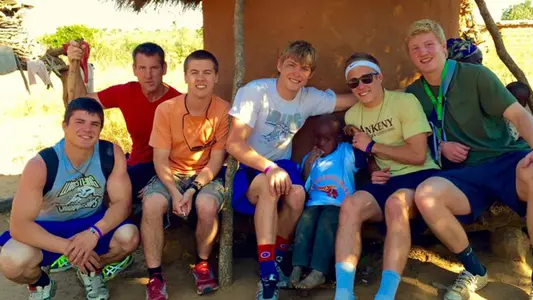
This summer, five Cyclones used their time to better themselves on the mat and to give back – in a big way. Austin Anderson, Duke Egli, Trevor Paulson, Colin Strickland and Drake Swarm all set out on a two-week mission trip to help the people of Zambia.
Zambia sits in the southern portion of the continent of Africa, and it is home to 14.5 million people. Like many African nations, Zambia struggles with the outbreak of Malaria and HIV/AIDS. The average life expectancy for a Zambian is just over 50 years old, leaving many children orphaned. The five Cyclones wanted to do what they could to help.
“Our motto for the whole trip was that we may not be able to help the entire country, but we can focus on one individual at a time and see how many individuals we can influence,” said Swarm.
The crew spends every Wednesday night in a group fellowship with many of the other Iowa State wrestlers and coaches. Their faith was also a driving force that led them to go on this trip.
“I wanted my faith to grow stronger and find a better perspective on life and what is important, and lend a helping hand to those less fortunate,” said Anderson.
The flight across the Atlantic Ocean took nearly 17 hours, and when it was all said and done, the five started their journey in the capital city of Lusaka. For the first week, they were centrally located in the city and stayed in a hotel.
“We had a bathroom and a bed, which I was impressed by,” said Strickland. “In the city we ate at different Zambian restaurants and got to eat some American food made in Zambia. It was different but still good.”
During their time in Lusaka, the Iowa Staters traveled around to many of the area schools and orphanages. The wrestlers described the classrooms as “tight” and “cramped.”
“Each school we went to had around 4,000 kids in it with an average of 80-90 kids in each classroom,” said Swarm. “Sadly, there are over 2 million orphans in the country.”
While visiting the schools and orphanages, the wrestlers provided many forms of service from playing with the kids, teaching, cleaning and even setting up medical help.
“We hiked 45 minutes to a school out in the bush and set up our own medical clinic where we tested around 70 children for Malaria, as well as distributing deworming pills,” said Anderson. “This was rewarding as well as saddening, because we witnessed young children being diagnosed with Malaria.”
Following their time in the city, they ventured to the IBCZ, a college where they stayed on the campus with the 80 students that live full time there, earning their degree. Their living conditions at the second stop were a little bit different than the hotel they stayed in.
“The second week we stayed at a college and got to sleep in a four person little cabin,” said Strickland. “It was pretty cool. We had mosquito nets hanging from the ceiling that we slept under.”
The food they ate at the second stop was also much different than the cuisine in the city.
“We ate things like beans, chicken, shema, which is a staple there that is kind of like rice and sometimes beef,” said Egli. “It was all prepared by people at the college.”
The school was an especially unique experience for the five because they got to interact with students who were their own age. They attended their classes, talked about their faiths and helped them tidy up the college itself.
All five agreed that their favorite part of their trip was the people that they got to interact with.
“The people there were all so genuine and selfless,” said Paulson. “Even though they have next to nothing, they would give us everything they had just to help us out. It was never about them.”
“The people there have practically nothing and yet they give willingly to those in need with no complaint,” said Egli. “Material items mean so little, yet we hold them in such high regard in the U.S. We need to follow their example.”
Along with everything that the five grapplers gave back on the trip, they all had something to take back with them to Ames to help them both on the mat, and in life.
“It taught me to be thankful for all that we're blessed with at Iowa State and to be a part of the wrestling program,” said Anderson. “It taught me to complain less about the busy life of being a student-athlete because in all reality, these things aren't worth complaining about.”